
Microchip has launched its second‑generation PolarFire FPGA Ethernet sensor bridge development board, now in production. Built around NVIDIA Holoscan sensor bridging technology, the new board shrinks footprint by 60%, doubles camera support (up to 4 inputs), adopts USB‑C power, and lowers pricing – all while replacing disparate sensor interfaces with a unified 10Gb Ethernet backbone.
Targeting medical devices, industrial robots, and humanoid platforms powered by NVIDIA Jetson and IGX, the board cuts BOM complexity and system cost. It includes a pre‑fitted connector for Jetson, onboard light‑delay measurement circuits, and works with NVIDIA’s latency toolkit to measure the full sensor‑to‑AI pipeline delay.
An FPGA Mezzanine Card (FMC) interface enables future expansions, while native support covers MIPI CSI‑2, I²C, UART, and GPIO – with optional add‑ons for SLVS‑EC 2.0, 12G‑SDI, HDMI, and DisplayPort without redesigning the base platform. PMOD headers further extend peripheral compatibility.
Microchip’s FPGA VP Shakeel Peera notes that engineers waste too much time on proprietary sensor interfaces. This board lets them focus on edge AI applications, leveraging low‑power PolarFire FPGA for a compact, high‑efficiency, secure hardware base that speeds commercial deployment.
The PolarFire FPGA brings built‑in power management, security, and reliability – critical for space‑constrained, power‑limited edge terminals. The platform comes pre‑loaded with NVIDIA Holoscan SDK, plus optimized routines, AI models, and reference designs to shorten development cycles.
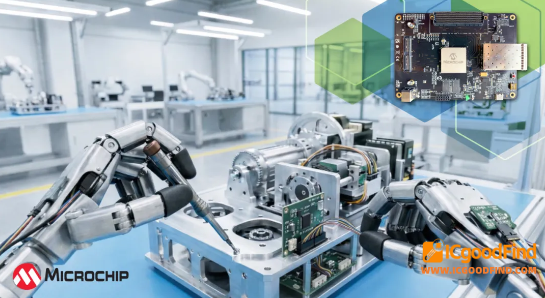
The complete kit includes cameras, cables, schematics, and reference layouts. Developers can use the Libero SoC suite for RTL coding. Onboard timing and power management ICs from Microchip are already verified with the FPGA, reducing debug risks – the whole power/clock architecture is production‑ready. This turnkey approach lowers total cost for Ethernet‑based edge AI devices, meeting the strict demands of industrial automation and robotics for fixed latency, low power, and compact size.
ICgoodFind Takeaway:
Edge robotics is heating up, and this FPGA bridge cuts sensor‑integration friction – helping AI products move from prototype to production faster.
